When Darkness Unlocked Art: The Photographer Who Learned to See Without Eyes
The Day the Light Went Out
Pete Eckert was thirty-one when retinitis pigmentosa stole the last of his sight. For years, he'd watched his peripheral vision shrink like a closing iris, but he'd adapted, compensated, held on. Then one morning in 1997, the tunnel collapsed entirely.
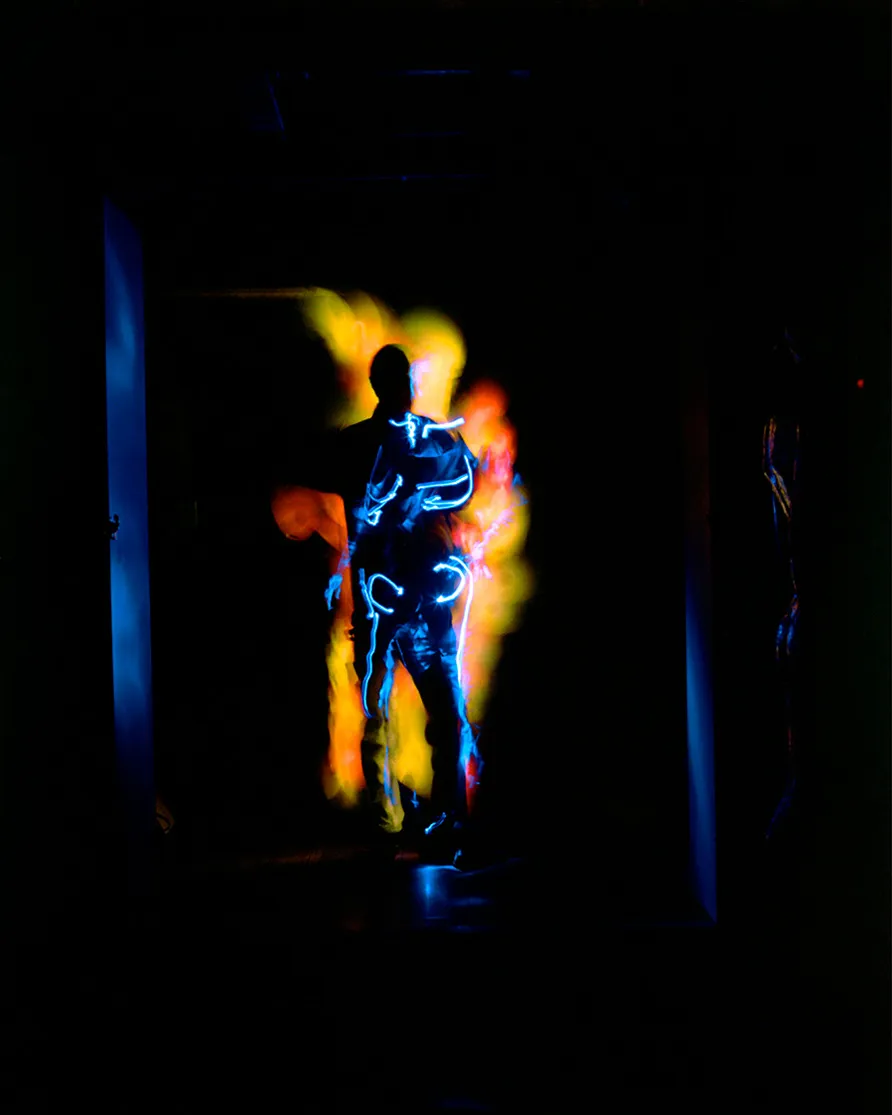 Photo: Pete Eckert, via peteeckert.com
He'd been a sighted photographer before the darkness came. Nothing groundbreaking—corporate headshots, wedding portraits, the kind of work that paid the bills but didn't set the world on fire. When blindness arrived, it seemed to slam shut not just his vision, but his entire creative identity.
"I thought I was done," Eckert recalls. "Photography was about seeing, and I couldn't see. Simple math."
But sometimes the simplest math is wrong.
Learning to Paint with Fire
Four years into his new reality, Eckert picked up a camera again. Not because he thought he could recreate his old work, but because he was curious about something entirely different. What if photography wasn't really about seeing at all? What if it was about feeling, moving, creating?
His first experiments were disasters by conventional standards. Blurry, abstract, seemingly random. But there was something in those failures that intrigued him—a quality that sighted photographers, bound by their reliance on visual composition, rarely achieved.
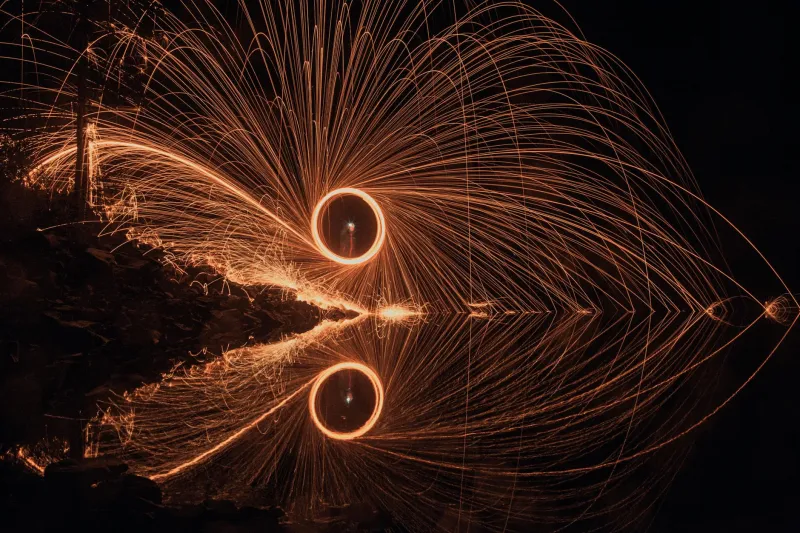
Eckert began developing techniques that had nothing to do with traditional photography. He used flashlights like paintbrushes, moving them through space during long exposures. He lit fires and captured their dance. He relied on his other senses—the warmth of light sources, the sound of his footsteps, the feel of wind—to guide his composition.
The Art World Didn't Know What Hit It
When Eckert's work started appearing in galleries, it confused people. These weren't the inspirational "triumph over adversity" pieces that audiences expected from disabled artists. They were genuinely innovative photographs that happened to be created by someone who couldn't see.
His "Motion Studies" series captured light in ways that challenged the medium itself. Streaks of illumination seemed to flow like liquid across the frame. Fire became sculpture. Simple flashlight movements transformed into complex geometric patterns that looked like they belonged in a physics textbook or a fever dream.
Critics struggled with how to categorize the work. Was it photography? Light painting? Performance art? The confusion was precisely the point.
Breaking the Rules No One Knew Existed
What made Eckert's approach revolutionary wasn't just the techniques—it was the philosophy behind them. While sighted photographers often chase the perfect moment, the decisive instant when all elements align, Eckert embraced chance and movement. His photographs captured time in a way that static, traditionally composed images couldn't.
"Sighted photographers are prisoners of what they can see," explains art critic Maria Santos. "Eckert was liberated from that limitation. He could imagine light in ways that vision actually prevents."
 Photo: Maria Santos, via casadecor.es
His process became almost choreographic. In his studio, he'd move through carefully memorized spaces, understanding the relationship between his body, his light sources, and the camera's position through repetition and spatial memory. Each photograph became a performance, with Eckert as both director and dancer.
The Teacher Who Learned by Teaching
As Eckert's reputation grew, something unexpected happened. Sighted photographers started seeking him out, not for inspiration, but for instruction. They wanted to learn his techniques, to understand how abandoning their reliance on sight could expand their creative possibilities.
He began conducting workshops where he'd ask participants to work in complete darkness, relying on their other senses to create images. The results were often revelatory—photographers who'd worked for decades discovered new ways of approaching their craft.
"He taught us that we'd been looking so hard, we'd forgotten how to see," says workshop participant and professional photographer James Chen.
 Photo: James Chen, via static.cinemagia.ro
Redefining What Art Can Be
Today, Eckert's work hangs in major galleries and private collections worldwide. His photographs have redefined not just what blind artists can achieve, but what photography itself can be. Museums that acquire his pieces often struggle with how to display them—do you emphasize the visual beauty, the innovative technique, or the artist's story?
Eckert prefers that the work speak for itself. He's not interested in being seen as a blind photographer or an inspirational figure. He's simply an artist who found his voice in the darkness.
The Light That Came from Shadow
Looking back, Eckert sees his vision loss not as a tragedy that he overcame, but as a redirection that led him exactly where he needed to go. His early corporate photography was competent but unremarkable. The work he creates now pushes boundaries and challenges assumptions.
"Losing my sight didn't end my career," he reflects. "It started my real career."
In a world that often treats disability as limitation, Pete Eckert's story suggests something more complex and more hopeful. Sometimes what looks like loss is actually liberation. Sometimes the thing that breaks you is the same thing that makes you extraordinary.
His cameras still capture light, but now that light carries something it never did before—the unique perspective of someone who learned to see the world not with his eyes, but with his entire being.