The Rejection Files: Six Brilliant Ideas That Almost Died in Boardrooms

Chester Carlson: The Patent Clerk Who Wouldn't Quit
In 1938, Chester Carlson was a patent attorney with arthritic hands and a brilliant idea. Tired of hand-copying documents all day, he invented a process he called "electrophotography"—what we now know as photocopying.
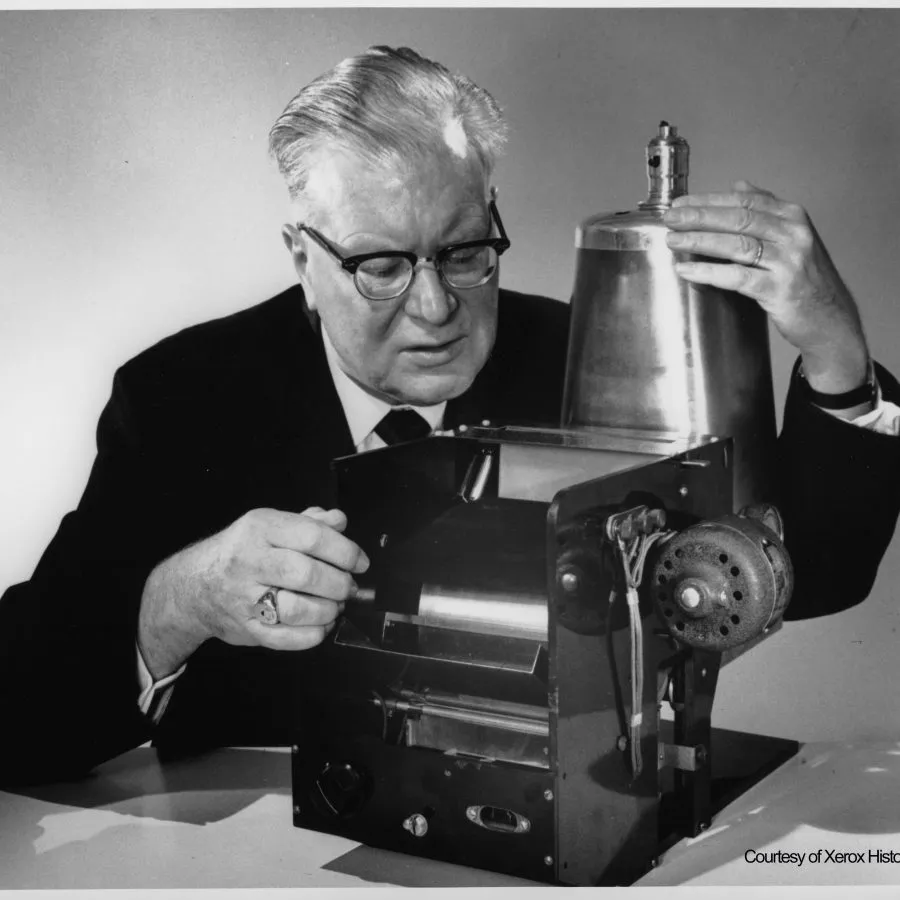 Photo: Chester Carlson, via memoriesofrxmp.info
For the next six years, Carlson hauled his crude machine from company to company, getting rejected by IBM, General Electric, RCA, and sixteen other major corporations. The feedback was consistent: "Who needs copies when you have carbon paper?"
IBM's rejection was particularly brutal. They told Carlson that his invention had "no commercial possibilities" and would never be profitable. General Electric said the process was "too complicated" and "unnecessarily expensive."
In 1944, a small nonprofit called the Battelle Memorial Institute finally agreed to develop Carlson's idea. Three years later, a tiny company called Haloid bought the rights and eventually became Xerox Corporation.
By the 1960s, Xerox was generating billions in revenue from the "unmarketable" invention that twenty companies had passed on.
Garrett Morgan: The Inventor Who Had to Hide His Identity
Garrett Morgan faced a problem that had nothing to do with his inventions and everything to do with his skin color. In 1914, the Cleveland-based inventor created the gas mask—a device that would save countless lives in World War I and beyond.
 Photo: Garrett Morgan, via suchscience.net
But when Morgan tried to sell his "safety hood" to fire departments across the country, orders mysteriously dried up whenever buyers discovered he was Black. So Morgan did something ingenious: he hired a white actor to pose as the inventor while he pretended to be an assistant.
The deception worked. Fire departments that had rejected Morgan's invention when they knew he was Black suddenly became eager customers when they thought it came from a white inventor.
The charade ended dramatically in 1916 when an explosion trapped workers in a tunnel beneath Lake Erie. Cleveland's fire chief called Morgan directly, begging him to help with the rescue. Morgan and his brother descended into the toxic tunnel wearing his gas masks and saved two lives.
The rescue made national news, finally giving Morgan the credit he deserved. But it took a disaster to overcome the prejudice that had nearly buried a life-saving invention.
Elisha Otis: The Elevator Pitch That Almost Failed
Before Elisha Otis, elevators were death traps. The cables broke regularly, sending passengers plummeting to their deaths. So when Otis invented a safety brake system in 1852, he figured customers would be lining up.
They weren't.
Building owners saw elevators as unnecessary luxuries. Why install an expensive, potentially dangerous machine when people had perfectly good legs? Otis's safety brake just seemed like an expensive solution to a problem most people didn't think they had.
Desperately seeking customers, Otis came up with a marketing stunt that would make modern PR professionals jealous. At the 1854 New York World's Fair, he stood on an elevator platform high above the crowd, ordered an assistant to cut the cable with an axe, and then calmly announced, "All safe, gentlemen, all safe" as his brake system prevented the fall.
 Photo: New York World's Fair, via 3.bp.blogspot.com
The crowd went wild. Orders poured in. Within a decade, Otis elevators were making skyscrapers possible and transforming American cities forever.
Ruth Wakefield: The Cookie That Happened by Accident
Ruth Wakefield wasn't trying to invent America's favorite cookie in 1938. She was just trying to make chocolate cookies at her Toll House Inn in Massachusetts, but she was out of baker's chocolate.
As a substitute, she chopped up a bar of Nestlé semi-sweet chocolate, expecting it to melt and distribute evenly through the dough. Instead, the chocolate pieces held their shape, creating something entirely new.
When Wakefield tried to sell her "chocolate crunch cookies" to local bakeries, they were politely uninterested. The texture was wrong, they said. Cookies weren't supposed to have chunks in them.
Fortunately, Nestlé disagreed. The company struck a deal with Wakefield: they'd print her recipe on their chocolate bar packaging in exchange for a lifetime supply of chocolate. They also bought the rights to the "Toll House" name.
The chocolate chip cookie became America's most popular cookie, generating billions in sales. Wakefield received her lifetime chocolate supply but never earned royalties from her accidental invention.
Stephanie Kwolek: The Fiber Five Times Stronger Than Steel
In 1965, DuPont chemist Stephanie Kwolek was working on lightweight, strong fibers for car tires when she created something that looked like a mistake. The solution was cloudy and strange-looking—exactly what chemists are trained to throw away.
Kwolek's colleagues told her to discard the batch and start over. The solution looked contaminated, they argued, and wouldn't produce usable fibers. But Kwolek had a hunch.
Against protocol, she convinced a technician to test the "failed" solution. The resulting fiber was five times stronger than steel by weight, lighter than fiberglass, and incredibly flexible.
Kwolek had invented Kevlar, but convincing DuPont to commercialize it took years. The company couldn't figure out what to do with a fiber that was simultaneously super-strong and lightweight. Early applications included tennis rackets and boat hulls.
Then someone realized Kevlar could stop bullets. Today, Kevlar body armor has saved thousands of police and military lives, all because one chemist refused to throw away what looked like a failed experiment.
Art Fry: The Bookmark That Became a Billion-Dollar Business
Art Fry had a problem that millions of church choir members would recognize: his bookmarks kept falling out of his hymnal during services. In 1974, the 3M scientist remembered a "failed" adhesive his colleague had created—a glue that was strong enough to stick but weak enough to remove without damage.
Fry coated paper with the adhesive, creating removable bookmarks. They worked perfectly, but when he pitched the idea to 3M executives, they were unimpressed. Who would pay for bookmarks when free ones were everywhere?
Fry persisted, creating samples and distributing them around 3M's offices. Gradually, people began using them not just as bookmarks but as removable notes. The "Press 'n Peel" bookmark was becoming something else entirely.
Even then, 3M's market research suggested limited commercial potential. Test markets in four cities produced disappointing results. But when 3M gave away free samples, demand exploded. People didn't know they needed Post-it Notes until they tried them.
Post-it Notes launched nationally in 1980 and became one of 3M's most successful products, generating billions in revenue from an adhesive that was originally considered a failure.
The Pattern Behind the Rejections
These stories share common threads that reveal how truly innovative ideas are received. First, revolutionary inventions often solve problems people don't realize they have. Second, they frequently challenge established ways of doing things, making them seem unnecessary or impractical.
Most importantly, these inventors succeeded because they understood something their critics didn't: the difference between an idea's merit and the market's readiness to accept it. They persisted not because they were stubborn, but because they could see possibilities others couldn't.
When "No" Doesn't Mean Never
Every rejection these inventors faced seemed final at the time. Corporate executives, investors, and experts all agreed: these ideas wouldn't work, weren't needed, or couldn't be profitable.
They were all spectacularly wrong.
The lesson isn't that every rejected idea is secretly brilliant—most rejections happen for good reasons. But it is a reminder that truly transformative innovations often look impossible until someone makes them inevitable. Sometimes the biggest risk isn't in pursuing a crazy idea—it's in walking away from one that could change everything.