The Touch of Genius: How a One-Year-Old's Tragedy Became Cambridge's Greatest Mathematical Mind

The Boy Who Learned to See with His Hands
In 1682, a one-year-old boy named Nicholas Saunderson lost his sight to smallpox in the small Yorkshire village of Thurlstone. His parents faced a grim reality: in 17th-century England, blindness meant a life of begging or basket-weaving at best. Nobody could have predicted that this child would grow up to hold Isaac Newton's old job.
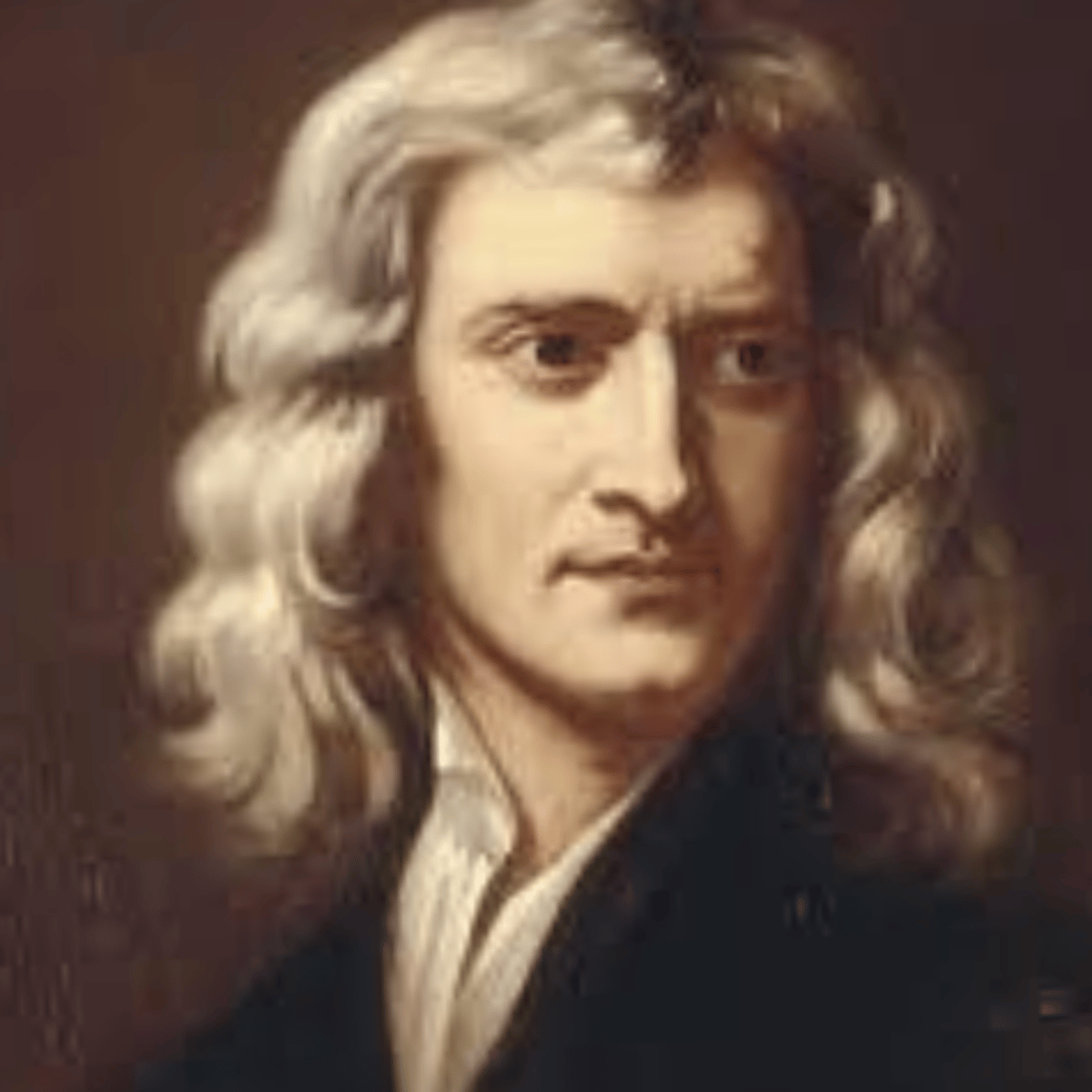 Photo: Isaac Newton, via imagedelivery.net
Saunderson's story begins not with tragedy, but with a father who refused to accept limitations. Rather than hiding his blind son away, Saunderson's father encouraged the boy's obvious intellectual curiosity. When young Nicholas showed an uncanny ability to solve problems in his head, his father found him tutors willing to work with a blind student—no small feat in an era when disability was often seen as divine punishment.
Building Mathematics You Can Touch
What set Saunderson apart wasn't just his brilliant mind—it was his revolutionary approach to learning. Unable to read mathematical texts, he developed his own tactile system for understanding complex equations. Using a board covered with pins and thread, he could "see" geometric shapes and algebraic relationships through his fingertips.
This wasn't just adaptation; it was innovation. Saunderson's tactile methods revealed mathematical relationships that sighted mathematicians missed. His fingers could trace the elegant curves of calculus, feel the symmetry of equations, and manipulate abstract concepts with a precision that amazed his contemporaries.
By his twenties, word of the blind mathematician from Yorkshire had reached Cambridge. But here's where Saunderson's story takes an extraordinary turn: Cambridge didn't invite him as a charity case or curiosity. They recognized genuine genius.
The Professor Who Never Graduated
In 1707, Cambridge University made an unprecedented decision. They appointed Nicholas Saunderson as Lucasian Professor of Mathematics—the same chair later held by Stephen Hawking—despite the fact that he had never attended university as a student. Think about that for a moment: the most prestigious mathematics position in England went to a man who had learned everything through touch and conversation.
 Photo: Cambridge University, via i.pinimg.com
Saunderson's lectures became legendary. Students packed his classroom not out of pity, but because he could explain complex mathematical concepts with a clarity that sighted professors envied. His tactile understanding of mathematics gave him unique insights into how abstract concepts actually worked.
He didn't just teach from textbooks—he couldn't read them. Instead, Saunderson developed entirely new ways of explaining calculus, algebra, and geometry. His students later said his teaching method made mathematics feel alive, like a language you could speak rather than symbols you memorized.
The Network That Changed Everything
Saunderson understood something crucial: brilliance means nothing without connection. He cultivated relationships with the greatest minds of his era, including Newton himself. These weren't charity friendships—they were intellectual partnerships between equals.
His home became an informal academy where mathematicians, philosophers, and scientists gathered to debate ideas. Saunderson held his own in every conversation, often surprising visitors who came expecting to meet an inspirational figure but found themselves challenged by one of England's sharpest mathematical minds.
Beyond the Numbers
What made Saunderson extraordinary wasn't just his mathematical ability—it was his refusal to be defined by what he couldn't do. While his contemporaries saw blindness as a limitation, Saunderson saw it as a different way of understanding the world.
He wrote extensively on optics—the science of light and vision—despite never having seen light himself. His theoretical understanding of how vision worked was so sophisticated that sighted scientists consulted his work. Imagine the irony: a blind man teaching others how to see.
The Legacy in Your Pocket
Saunderson's influence extends far beyond 18th-century mathematics. His tactile teaching methods laid groundwork for modern educational approaches that recognize different learning styles. Every time a teacher uses hands-on learning or encourages students to "feel" their way through a problem, they're using techniques Saunderson pioneered three centuries ago.
More importantly, Saunderson proved that genius comes in forms society doesn't always recognize. He showed that the absence of one ability can sharpen others to extraordinary degrees.
What Saunderson Saw
Nicholas Saunderson died in 1739, having held the Lucasian chair for over thirty years. His funeral was attended by mathematicians from across Europe—not mourning a disabled man who had overcome odds, but honoring one of the great mathematical minds of their generation.
Saunderson's story reminds us that limitations often force innovations that change everything. His blindness didn't prevent him from seeing mathematical truth—it gave him a unique way of perceiving it that sighted mathematicians couldn't match.
In a world obsessed with traditional credentials and conventional paths to success, Saunderson built his reputation entirely on merit. He never attended university, never read a textbook, and never saw an equation written on a blackboard. Yet he became one of England's most respected professors.
Sometimes the clearest vision comes from those who have learned to see with something other than their eyes.